Beeswax is not gathered from nature like nectar or pollen. It is a bio-synthesized masterpiece, created by young worker honeybees (Apis mellifera) during a specific stage of their lives, typically around days 12–18. This remarkable natural material (beeswax) serves as the structural foundation of the hive [1].
Unlike paraffin wax derived from petroleum refining or waxes made from chemically hydrogenated plant oils, natural beeswax is a complex Living Matrix—a remarkable network of more than 300 distinct compounds, composed primarily of long-chain esters, hydrocarbons and fatty acids. Its physical profile shifts continuously depending on botany, season, and hive history [2].
The Colour of Beeswax
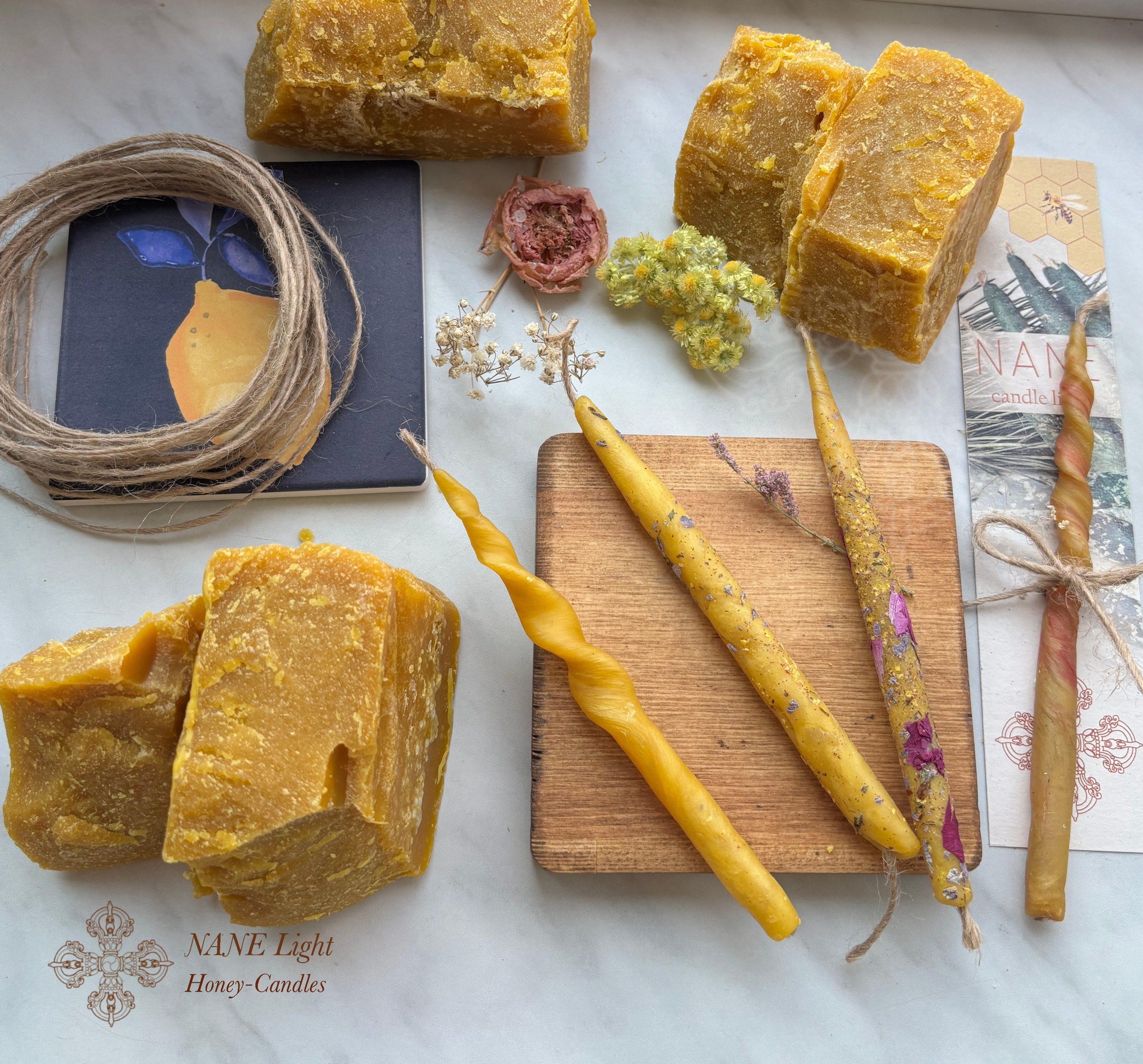
In its purest, freshly produced state, beeswax is white and translucent [1, 2]. Its beautiful spectrum of golden hues—ranging from pale cream and butter yellow to deep amber and bronze—develops entirely within the hive.
The Texture of Beeswax
Pure beeswax possesses a unique balance of density and malleability that synthetic alternatives cannot match. Beeswax's melting point sits remarkably high for a natural lipid—between 62°C and 65°C (144°F to 149°F) [2, 3].
The Aroma of Beeswax
The scent of pure beeswax is an atmospheric footprint of the landscape from which it grew. It does not carry an artificial or singular perfume, but rather a warm, complex bouquet.
High-grade beeswax releases a soft, sweet note of warm honey undertones paired with subtle herbaceous, woody, or resinous hints [4]. When warmed or burned, it emits a clean scent without releasing toxic volatile organic compounds (VOCs) or soot typical of synthetic petroleum candles [5]
The Surface of Beeswax and the Phenomenon of "Bloom"
Over time, pure, unadulterated beeswax undergoes a natural transformation known as bloom. This appears as a soft, velvety white film or frosted haze across its surface.
Far from being a defect, bloom is the definitive hallmark of absolute purity [10]. It occurs because the lower-melting-point oils and free fatty acids within the wax slowly migrate to the surface over time and crystallize upon exposure to cool temperatures [10]. Bloom can be wiped away with a soft cloth or dissolved with gentle heat, but its presence provides visual proof that the wax has not been blended with paraffin, microcrystalline, or synthetic additives [6].
- [1] Hepburn, H. R. (1986). Structural and physiological aspects of wax secretion. In Honeybee Wax: Production, Properties, and Uses (pp. 1–22). Springer, Berlin, Heidelberg.:
- [2] Tulloch, A. P. (1980). Beeswax—composition and analysis. Bee World, 61(2), 47–62.
- [3] Buchwald, R., Breed, M. D., & Greenberg, A. R. (2008). The viscoelastic properties of beeswax: Implications for honeycomb stability. Journal of Experimental Biology, 211(1), 88–94.
- [4] Ferber, C. E. M., & Nursten, H. E. (1977). The aroma components of beeswax. Journal of the Science of Food and Agriculture, 28(6), 511–518.
- [5] Massaro, C. F., et al. (2015). Chemical characterisation of stingless bee resins and propolis. Phytochemistry, 115, 120–127.
- [6] Gaillard, Y., & Pratt, P. (1983). Surface crystallization and phase transitions in natural beeswax matrices. Lipids and Polymer Sciences, 38(2), 142–148.

«Երկ-միություն» Մաքրող Մեղրամոմ

ԲՆԱԿԱՆ ԲՈՒՅՐԵՐ… ավելի քան մոտ ԲՆՈՒԹՅԱՆԸ

Cosmic Light of «GURU» Collection - NANE Light Honey Candles

Մեղրամոմ ու Խունկ
